
Overview of boxing
Olympic Style Boxing
Men and women from the GB Boxing squad compete in Olympic-style boxing (sometimes referred to as Amateur Boxing) in international competitions that are overseen by World Boxing, which is the international federation for boxing recognised by the International Olympic Committee (IOC) at global level.
Olympic-style boxing is the most common form of international boxing and the one used at the Olympic Games and major global and continental championships. It is also the format practiced in thousands of boxing clubs in Great Britain that are affiliated to the three national governing bodies (NGB) for the sport, England Boxing, Boxing Scotland and Welsh Boxing, which are all members of World Boxing. GB Boxing is an associate member of World Boxing, as it is not an NGB.
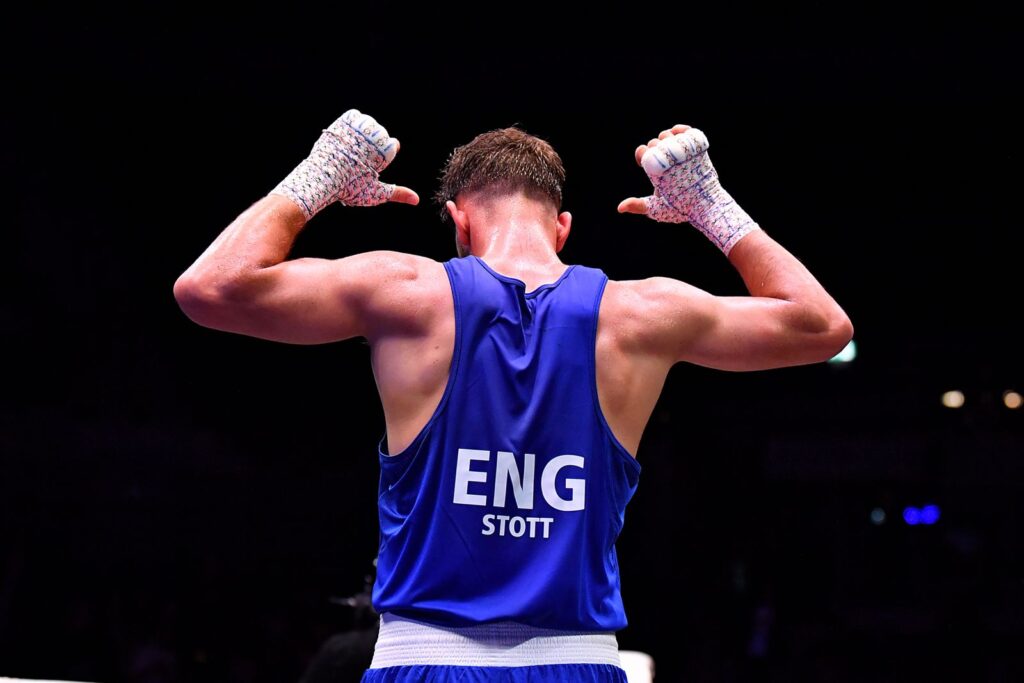
It means that when men and women from the GB Boxing squad compete in international competitions they box in their home nation vest and represent England, Scotland, or Wales. The only time the boxers represent Great Britain is at the Olympic Games when they compete for Team GB.
Under World Boxing’s competition rules (which can he viewed HERE) all bouts for men and women at elite level take place over three rounds lasting three minutes each and separated by a one-minute break. All boxers wear vests and protective gloves and mouthguards. Women also wear a protective headguard.
Bouts are scored by judges using the ‘10 point must’ system where the winner of each round is awarded a score of 10 while the opponent is given nine or fewer. Seven is the minimum score which can be given to the loser of the round. Every round must have a winner and cannot be scored a draw.
At the end of three rounds, the boxer who has the most points on the majority of the judges’ scorecards is declared the winner. Bouts can also be stopped if a boxer is knocked down and unable to resume boxing by the time the referee has counted to ten or if one of the boxers is knocked down three times in a single round. Referees can also bring contests to an end if one of the boxers is injured to the point where it is unsafe for them to continue or if there is a significant imbalance between the capabilities of the boxers.
In World Boxing competitions there are 10 weight classes for both men and women. At the Olympic Games, there are seven weight categories each for men and women. The weights used in World Boxing competitions are listed below; those highlighted in red are the Olympic weight classes that will be used at LA 2028.

There are 10 weight classes for men and 10 for women following changes set to take place from 1 January 2025. Those highlighted in red are potential Olympic weights ahead of LA 2028. The weight classes will be:
| Male Weight Classes | Female Weight Classes |
| Flyweight, 47-50kg | Light-flyweight, 45-48kg |
| Bantamweight, 50-55kg | Flyweight, 48-51kg |
| Lightweight, 55-60kg | Bantamweight, 51-54kg |
| Welterweight, 60-65kg | Featherweight, 54-57kg |
| Light-middleweight, 65-70kg | Lightweight, 57-60kg |
| Middleweight, 70-75kg | Welterweight, 60-65kg |
| Light-heavyweight, 75-80kg | Light-middleweight, 65kg-70kg |
| Cruiserweight, 80-85kg | Middleweight, 70-75kg |
| Heavyweight, 85-90kg | Light-heavyweight, 75-80kg |
| Super-heavyweight, 90+kg | Heavyweight, 81+kg |